
Your peer review report arrived—what should you do?
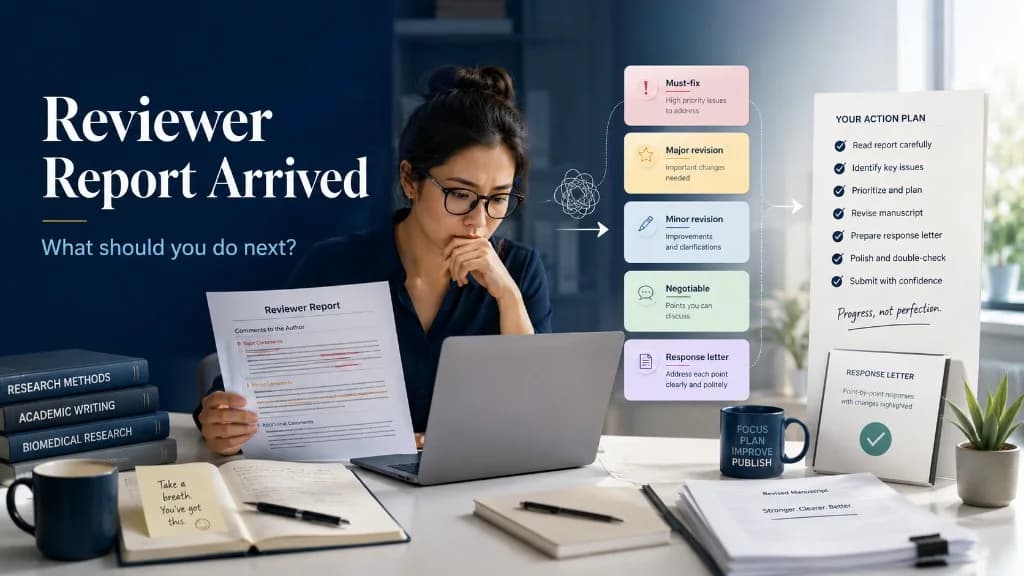
A reviewer report is usually a request to revise, not an outright rejection. Read it analytically, separate major from minor revision, and turn each comment into a tracked change plus a response in your letter.
Why does the report feel difficult at first?
For many researchers, receiving a report is:
- stressful
- demoralizing
- easy to take personally
Yet a reviewer report is:
- not the same as rejection
- feedback, not personal attack
The first step is to read it analytically, not emotionally.
Step 1: Read the editor’s decision correctly
Before the detailed comments, read the editor’s decision line carefully:
- Major revision
- Minor revision
- Revise and resubmit
This frames scope, depth, and timeline for revisions.
👉 Decision types explained here:
What does major revision mean?How many of these issues are in your manuscript?
Not sure? Upload it and get a preview list tailored to your paper.
No card required.
How to sort reviewer comments
It helps to group comments into:
- Must-fix items
- Negotiable items needing strong rationale
- Comments that are incorrect or off-target
This structure becomes the backbone of your response letter.
Common mistakes
- Shallow replies to comments
- Saying “we disagree” without evidence
- Rushing a short response letter
- Claiming changes without updating the manuscript
These are especially dangerous after major revision.
How to write the response letter
A strong response letter:
- uses respectful language
- answers each point
- clearly states what changed
- uses line or page references when helpful
Reviewers infer seriousness from the quality of the letter.
Acceptance odds after the report
This depends on:
- revision quality
- clarity of responses
- whether the editor is persuaded
After minor revision, thorough revisions often lead to acceptance.
👉 More on minor revision:
What does minor revision mean?Can risks be seen before the report?
Often, yes.
Many criticisms are predictable with a careful read before submission.
That is why pre-submission evaluation matters alongside understanding the peer review process.
What pre-submission review offers
It surfaces:
- where reviewers are likely to push back
- sections that will need revision
👉 Full framework:
Scientific manuscript evaluation and pre-submission reviewConclusion
The reviewer report is:
- not the end of the process
- the start of the path to acceptance when managed well
Most desk rejects come from issues you could spot before you submit
Review your manuscript with a reviewer-style eye before you send it.
Free preview · no credit card · full report $19